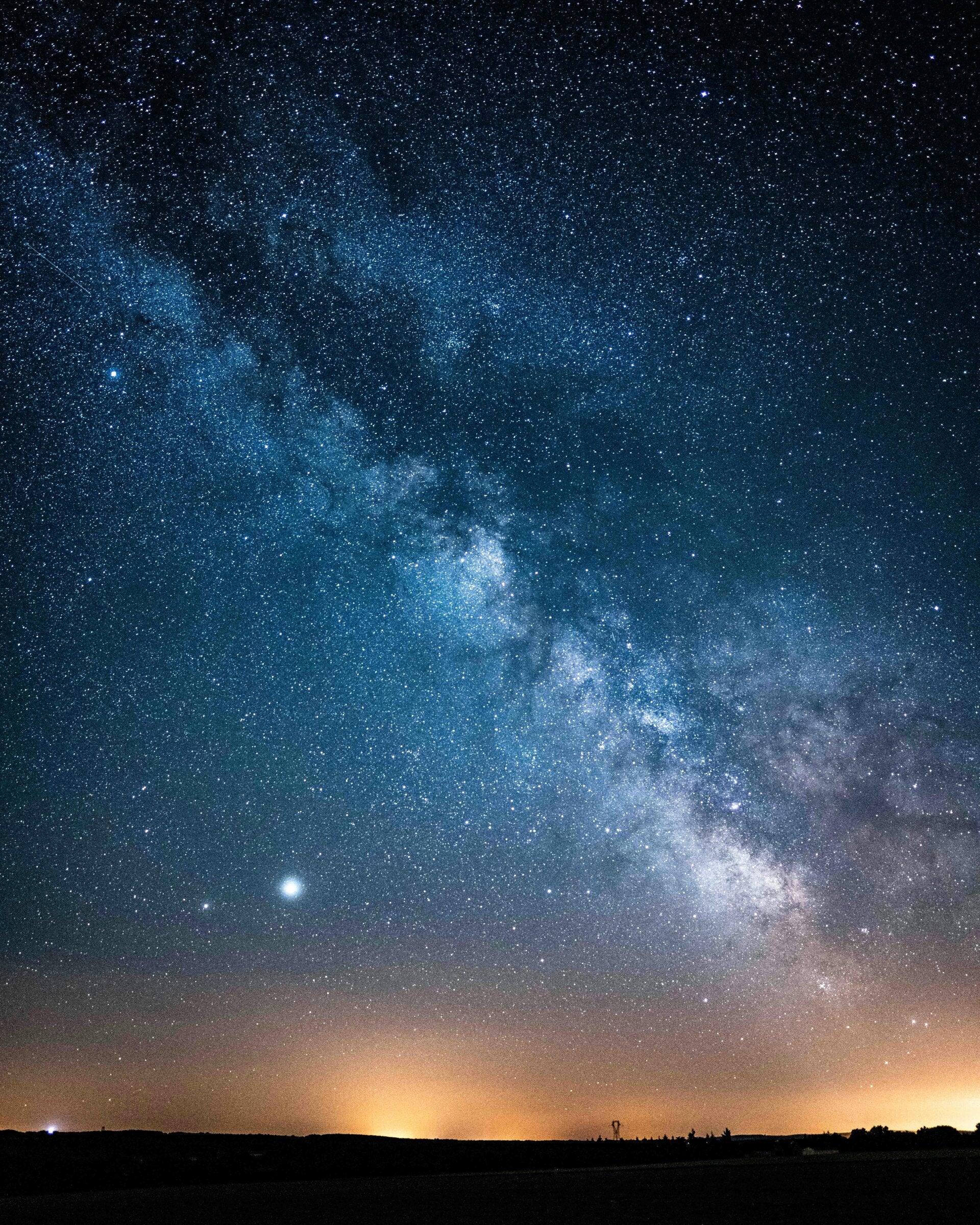
My philosophy is simple and approaches the child, family, community, environment and my own role with the reverence and gravity they require. I speak the language of astrology, like any language, my mind thinks along the lines of its unique parameters. When I look at young children, I see them as wide, shining constellations, families as their essence-imbuing ruling planets, educators as the perspective from earth that enlightens our observations and makes way for the sky to be divided into developmental areas. Our community is naturally made of the relationships or aspects between various planets, constellations, and areas of sky where together we create an impact. The environment is the ever-patient cycle of time, the movement we see happen rhythmically in the sky that we bond with to move more wisely. We are so integral to one another, and as I see how all of us represent the interconnecting pieces that are set aglow in our celestial universe, I look to each of us with the same wonder, hope, and curiosity that is ignited in me when I look up at the night sky.
I believe children are whole, they must be heard and observed closely and compassionately to aid them in connecting to their innate gifts. When we view children as constellations, we register that they come in whole and multifaceted, a unique embodiment that needs connection. Like the way we draw connections between stars, the children are whole because they come in complete, but there are these connections we assist in drawing (similar to the synapses in the brain) that allow them to come into themselves and shine. I sincerely appreciate “Indigenous community contexts for teaching-learning, shedding light on the gifts, skills, and capabilities of the child” (Peltier, 2021, p. 2). Their development is an unravelling of their unique gifts, a process of making the necessary connections so that the radiance that lives inside of them can effectively flow out into the wider word. I practice an attentive and compassionate way of being with the children in care. I am ready to offer them my full attention, get on their level and listen to them in all the ways they communicate.
I believe the family is a whole ecosystem that serves as the first and most important teacher for their children. When we view the family as the planets alight in the sky, we honour the way they shine like a million stars coming from a sole source. These big, bright planets infuse constellations with their energy, in astrology we call them “rulers,” but I have always thought of them like their primary caregivers because they are inextricably unified and exchange energy that forms them both into who they are. “A family is not simply a group of individuals who operate or behave independently from one another; rather, a family operates on the principle of wholeness” (Bigner & Gerhardt, 2014, p. 56). This ideology honours how the family self-sustains; they are strong and wise, or whole. “The family group must be considered in its entirety to understand how it works… a family is seen as being greater than the sum of its parts” (Bigner & Gerhardt, 2014, p. 56). Families and their children “share a mythology” astrologically speaking, so when they come together, we can understand both more richly by learning about the other. I run family-centred-practice experiences regularly where my deeper interest and connection with families dictates the numerous varied ways to participate in classroom involvement activities, and how ever they decide is best for them to proceed is respected.
I believe the educator is dutiful, they are indebted to uphold a certain quality of service, and build spaces or opportunities to promote growth. This is like the astrological concept of developmental areas or “houses” that are drawn from our rooted perspective on earth. The earth in astrology is associated with structure and growth, and only from our place on earth can we “draw houses.” These are carved out spaces that offer a container of opportunity and challenge through all the life areas. They also act as a sort of clock and honour the passing of time. As educators we are observing from a growth-minded perspective, honouring their milestones and expanding their knowledge and abilities in a balanced way. To uphold this vision, it is important that “educators are lifelong learners. They take responsibility for their own learning and make decisions about ways to integrate knowledge from theory, research, their own experience, and their understanding of the individual children and families they work with” (Ontario Ministry of Education, 2014, p. 7). Taking responsibility for my own learning and taking my post seriously is something inlaid in the way I approach my continuing education. I make the most out of the opportunities I get, striving for my best effort and communicating with mentors to get feedback. My deep and well-balanced learning is reflected in the way I thoughtfully observe, set up and run experiences for children.
I believe the community is capable of mobilizing under the right relational circumstances to make an impact on the world.This directly correlates to the role of aspects in astrology, these are the connections between different planets and constellations that offer both friction and ease. These relationships are how we really see each other, and by joining together in purposeful ways we create an impact. Community is emboldened by relationships “when you engage in a practice of relationships, you create places of vitality…with children as mighty learners and citizens–and their families…places of vitality are strong, active, and energetic communities” (Robertson, 2019, para. 4). Engaging in relationships is something that I thrive off of as an educator and a person. Regular, compassionate conversations with people are the foundation of my approach to bonding with children, families, fellow professionals, and any other individual. Taking the time to regularly connect forms bonds which gives everything else the energy to emerge.
I believe the environment is a wise teacher, waiting for our attention and patience to learn the way. This element from astrological perspective connects to the rhythms and cycles of planetary movement. Everything is in motion coordinated with these greater patterns, when we acknowledge the cyclical movement and take note, we all become better prepared for life and more attuned to nature’s wisdom. I heartily agree that “children must first build relationships with the land and territory to become its stewards. These protocols, practices and traditions are customarily passed through the generations when young Indigenous children hear the stories, experience their environment, participate in the ceremonies, practice food harvesting and preparation, and understand the languages” (The World Forum, Indigenous People’s Action Group, 2020, p. 4). Learning from the land allows for respect and responsibility to grow and continued care to flow towards the land that supports us. Whether the learning is based in preserved cultural practices that are rooted in the territory, or more general nature-based experiences, we all benefit from tuning into the environment. The environment as a living, breathing teacher is what I always hope to impart in the nature-based and culturally relevant daily programming experiences.
Family-Centered Practice (FCP) is a model that I really resonate with because I think of the child and family as a unit that is so inextricably linked they rely on each other to do their best. When a family is included in their child’s learning that child thrives and because of their connection, this involvement begets their growth as a unit. I want to make families feel welcome, at ease, and involved with their child’s journey. Making this evident starts with implementing the planning-rich elements of FCP I am very experienced in like calendars, book lists, conversation prompts, and activity kits for families to take home. As well as direct involvement events (where the families are invited to contribute to the class) that reflect many options to be sensitive to schedules and comfort levels. Genuine connections with families (that make us into a real team in their child’s educational journey) make me excited because I can clearly see families learning from and being inspired by each other. Etuaptamuk, or two-eyed seeing, integrates Indigenous worldviews with the scientific lens of child development we are looking through as educators. This approach involves the culturally specific Indigenous ways of being and an emphasis on environmental connection and protection. I am inspired to widen my perception of the children in my care and remain open to their unique abilities, as well as connect to our natural world. This allows me to help children from all kinds of cultural backgrounds nurture a deep relationship with the land and their roots. I enjoy building homemade books with natural props that ignite imagination and empathy for the land and its inhabitants. Laying out art materials for process-based art experiences is a wonderful way to honour the inlaid gifts in children, giving them an opportunity to play out their interests and build upon their skills.
References
Bigner, J., & Gerhardt, C. (2019). Parent-child relations: An introduction to parenting (10th ed.). Pearson.
Ontario Ministry of Education. (2014). How does learning happen? https://files.ontario.ca/edu-how-does-learning-happen-en-2021-03-23.pdf
Peltier, S. M. (2021). The child is capable: Anishinaabe pedagogy of land and community. Frontiers in Education, 6(689445).https://doi.org/10.3389/feduc.2021.689445
Robertson, B. (2019). Indigenous ways of knowing: The early learning perspective. https://childcarecanada.org/sites/default/files/Indigenous%20Ways%20of%20Knowing_0.pdf
World Forum Foundation, Indigenous People's Action Group. (2020). Indigenous early care and education understandings and perspectives. https://worldforumfoundation.org/wp-content/uploads/2020/07/2020-03-12-FS-WFF-IPAG-Indigenous-Early-Care-Resources-FINAL-Web.pdf
Create Your Own Website With Webador